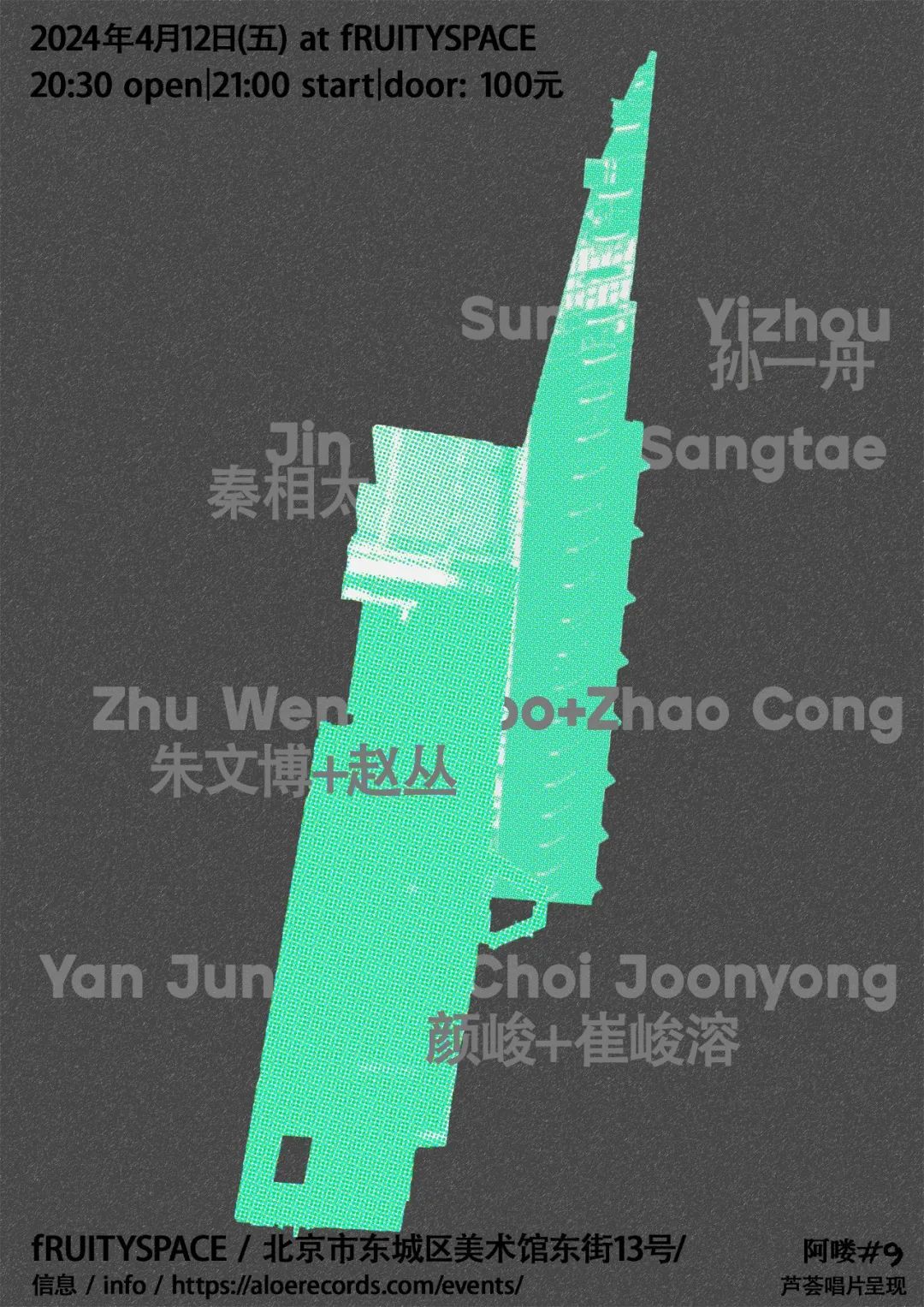
Friday 12 April 2024, Beijing, Aloe on-site #9
Your humble correspondent, accompanied by his incorrigibly humourless conceit (with which he naively hopes to win over one of his two or three readers), re-emerges to report on the Aloe Records concert series. You will be relieved to hear that we will dispense with the questionably impressionistic approach which marked the inaugural issue (The Sine Revue does not however categorically rule out its return in the future). It is yet another evening in Beijing in which we find ourselves below street level in the centrally located Fruityspace. The first performance was given by none other than the proprietor of Aloe Records himself, Mr Sun Yizhou.
A final conversation with Boss Zhai to have the lights turned off. Sun Yizhou 孙一舟 has arrayed three tables in column formation directed towards the audience. He activates a digital metronome placed on the furthest table. After a short moment, a mechanical time keeper on the centre table is set in motion at a slightly different tempo, and finally he turns on a strobe light, set to a very low period, which clicks faintly when it flashes. Sun Yizhou stands in the space between transistor and pendulum, a public statue after dark intermittently lit by a faulty light. Another beating is introduced: the body of Sun Yizhou jumps ragdoll-like up and down. Four rhythms. The first two of the sequence, as one might expect, constitute a perfect regularity, but the flashing of the light exhibits a curious temperamentality, then, illuminating the animal dimension which is not, in any case, concerned with such orders. What does it mean, your correspondent asks himself? He nonetheless finds himself quite moved by the formal composition, four stitches in speculative proximity. The air is tranquil, the room curiously sanctified by the contemplation of the sounds of oscillation and of shoe, fabric, breath.
In this same space now removed of furniture and bathed in light, Zhu Wenbo 朱文博 and Zhao Cong 赵丛 stand some metres apart, facing one another. Each hand holds a speaker, one functioning as a microphone, I presume, and the other emitting fragile shifting waves, sounding the text of a sheet of paper resting on top. The secrets of their instruments I cannot decipher, save to observe that they are connected not only by the wires of their equipment but also by the wires of sight. Zhu Wenbo maintains an impeccable stillness, by contrast Zhao Cong makes subtle, diminutive movements. Her paper falls to the ground. Zhu’s sole motion, an act of solidarity, is to let his do the same, only seconds before a helping member of the audience replaces Zhao Cong’s paper to its original position. For quite some time, we are all listening intently to the sound of an invisible tearing. Suddenly, they throw their trinkets onto the floor before them, breaking the chant of the machine.
Jin Sangtae 秦相太 begins in darkness with a generic wash which sounds and which I will later confirm is digital. I am drawn in by its steady crescendo, and right as I begin to nod my head to the rhythmic undercurrent, he ends it and switches on a small light illuminating the array of deconstructed motors, mixer, and other devices on the desk. The remainder of the performance involves the disgusting amplification of the mechanism — astonishing beauty — and the fine tuning of the complexities, quite possibly the only acceptable orchestration of complexity (I promise that this is not the condemnation of faint praise). Sangtae, who has been conducting the affairs, shocks me when he slams his wooden fist on the table. Sound is, more or less, over. We are left with a few moments of something else, as shiny pieces of metal on a rotating disk drive refract light throughout the room. I heard a while ago that Yan Jun coined the term light industrial music to describe the Korean style. I would only add by way of commentary that in its commitment to the mechanical it is far more industrial than its etymological predecessor ever was.
Yan Jun 颜峻 and Choi Joonyong 崔峻溶 presented a triple sculpture: body, image and object. In the beginning, not altogether silent, a tranquil sonic field. A pre-recorded Yan Jun is projected upstage, strangely more captivating than the man himself who is moving in a movement of dialogue. Joonyong operates a mysterious contraption draped in foil – it will later come to life as a ping pong ball dispenser, launching haphazard projectiles at the audience, much to our delight (unlike the lottery, seemingly everyone is a winner). As the performance progresses, the friction of the dispenser’s moving parts causes a fragrant, heated and delicate aroma to waft around the room. Joonyong disappears under the foil to take possession of the machine. As this tall automaton ambles about, it knocks the ceiling mounted projector, all but decapitating the Yan Jun of the image, whose living original has disappeared into the audience to join in the play of retaliatory ball tossing. I start to pay attention to the sublime regularity of the sound of a vacuum cleaner or more likely a hand dryer in operation in some hidden, adjoining space. But now Joonyong exits the stage and we concentrate our gazes on the video Yan Jun, whose increasingly dramatic gestures reveal him, in my mind’s eye, as the master of ceremonies, and which partially foretell the sudden intrusion of The March of the Athletes. If I call it red music, I am sure you get the idea. The audience, every member of whom, save myself and perhaps our two Korean guests, is intimately familiar with the song, responds with a certain emotion which I can only describe as a mixture of humour and pathos. After the concert I was told by my neighbour, if I understood him correctly, which is far from certain, that that piece is used in the schooling system for certain exercise activities. It’s not the first time I have encountered the deployment of ‘revolutionary music’ in a performance context, and I suspect it won’t be the last.